

A form of Occam’s razor can be applied planning policy: the most effective policy is a simple one, and the most effective change to policy is the simplest one. This is – simply – because a decision-maker finds it much easier to understand and use.
We can see how this has played out in recent phases of planning reform. The zonal system proposed in the 2020 Planning for the Future White Paper was not necessarily a bad idea, but the changes it demanded were big and complicated, so that few in the profession could get a handle on how the transition to it would be achieved in practice. Discretionary planning allows for case-by-case nuance and, as the risks of throwing out a cute, gurgling baby with the tepid bathwater became apparent, the idea was ditched. But the key 2020 reform that did survive was design codes, that could be given teeth by making Supplementary Plans statutory. It survived because it was dealing in components that planners could understand. Yes, there was a political backlash that weakened the then government’s resolve, but it’s clear to me that the complexity of changing to zonal planning was fundamental to its failure.
In this context, the current cycle planning reforms need a thorough tidying with Occam’s razor. What cannot be understood cannot be implemented. Repeatedly with planning reform we see sound analysis of the problems, but then either incomplete or over-complicated solutions. Nowhere is this more apparent than with the ‘grey belt’.
Undoubtedly, there are sites in the Green Belt where the protection from development that Green Belt policy affords them is skewing decisions about what the optimal use of those sites might be. This boils down to the fact that ‘inappropriate development’ is harmful in principle, so the beneficial outcomes – such as affordable homes and recycling brownfield sites – have to be very hefty to outweigh both the in-principle harm and any case-specific harms, such as a landscape impact. But how to shift the scales more towards development on those sites, without opening up the rest of the Green Belt to being eroded?
Once upon a time in 2024, someone in Labour’s election campaign machine thought up ‘Grey belt’ as a neat term to refer to land that was in the Green Belt but wasn’t, well, green. ‘Poor quality and ugly’, in fact. That was the first mistake because, as any planner knows, greenness is not actually a required attribute of Green Belt; the key features of Green Belt are openness – i.e. not built-up, and permanence. Unfortunately, permanence has come to mean ‘won’t be developed during the current plan period’, which has led many Green Belt areas to be reduced to long-term areas of search for development land. Landowners with edge-of-settlement land in the Green Belt play a long game, waiting for some future government to open a policy window that will give them a shot at planning permission. This waiting game has perverse impacts: knowing that your land is not going to get permission for development holds down its value and should improve the prospect of it being used for nature and/or recreation. If this were the case, then the natural and social value of the Green Belt would grow over time. But if ‘permanence’ is up for grabs, and you might get planning permission in twenty years’ time, then you have ‘hope value’, and the very last thing you want is to allow nature to regenerate and become ecologically valuable and loved by local dog walkers and birdwatchers. So you put some Heras fencing round it, spray it with weedkiller once a year, store some junk on it. Then, at some point, a politician is gazing absent-mindedly out of the car window while being driven to a meeting, and they see that shabby scrap of land and think, ‘Why the hell is the planning system stopping sites like this from having some lovely houses built on them? This isn’t Green Belt, it’s….it’s….I KNOW! It’s Grey belt!’
Then began the challenge of designing planning policies for grey belt. The December 2024 NPPF tackles this in three stages. Stage 1 defines the terminology – what is grey belt – and refers us to para 143 to determine whether a given site meets the definition. In stage 2, para 155 changes the parameters of what constitutes inappropriate development. Stage 3 comes in para 156, setting out some ‘golden rules’ that apply to housing proposals.
Earlier this week I explored this policy change with some third year planning students. Sometimes in my university teaching I use a fictional village to test ideas out. Let’s call it Woodford. It’s a medium-sized village with a Conservation Area around its historic core, a derelict factory on one edge which is also in a floodplain, and several chunks of 20th century development including an inter-war council estate and a 1990s private development. It is surrounded by Green Belt. We don’t know where in the country it is: it could just as easily be in Cambridgeshire or South Yorkshire – it’s quintessential.
On the northern edge of Woodford, there is a proposal for housing development of, say, 60 homes, in the Green Belt. I asked the students to figure out whether it would qualify as grey belt and, if so, whether the new NPPF would increase its chances of getting planning permission. Here’s what they found – I assure you they sussed most of this themselves and I tried hard not to lead their thinking.
Stage 1: definition

The students furrowed their brows for a while at this, because of the clunky logic and circuitous negative clauses: “and/or…in either case, does not strongly contribute….excludes land where…other than….” Oof! But eventually we got there. What it’s actually saying is: Any piece of land – brownfield or greenfield – that’s in the Green Belt can be considered Grey belt unless it has an environmental designation, or is strongly contributing to any of purposes (a), (b) and (d).
OK, let’s go to para 143 to see if our site qualifies.
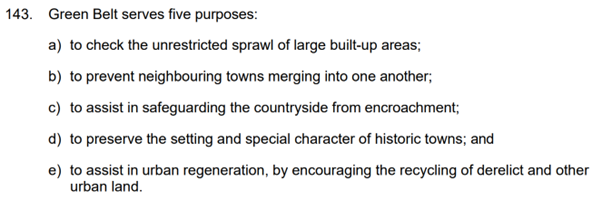
The site is on the edge of a stand-alone village, not a town. Therefore it cannot play a role in preventing the sprawl of a large built-up area, nor prevent towns from merging. So (a) and (b) don’t apply. It’s a village with a historic core and a beautiful historic church, but it’s not York or Canterbury, so (d) doesn’t apply. It will have a negligible effect on urban regeneration (e) not least because the local authority is doing pretty well at getting its urban brownfield land to come forward for development. The site is strongly fulfilling (c) – safeguarding the country from encroachment, but the grey belt definition doesn’t refer to that.
Once the students went through that part of the exercise they realised that grey belt could be defined even more succinctly: ‘it’s OK to encroach into the countryside so long as you’re not compromising (a), (b) or (d)’. Looked at this way, it’s achieving almost the opposite of what it says on the tin. Scrappy land with Heras fencing in the narrow slip of Green Belt between Leeds and Bradford? Not grey belt. Pleasantly average green field on the edge of a medium-sized standalone village? Grey belt!
At this point, several students asked: ‘What’s to stop the next site along coming forward and qualifying as grey belt too?’ It’s a great question, and to try and answer we have to move into stage 2.
Stage 2: Is it inappropriate development?
Let’s look at NPPF para 155.
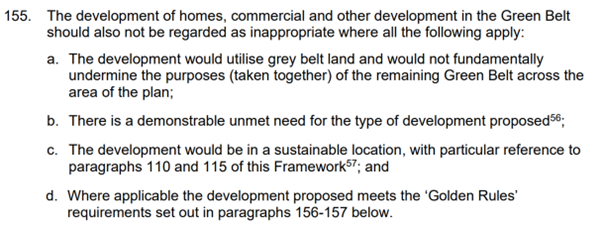
In stage 1 we established that our test site did qualify as grey belt. This gets us through para 155 as far as the seventh word of part (a) – it utilises grey belt land. The next bit of part 155(a) addresses the students’ question about sequential or cumulative bites, because at some point we reach a threshold where the grey belt bites add up, and any further bites would ‘fundamentally undermine the purposes’ of the remaining Green Belt. Considering the exclusion of countryside encroachment from the grey belt criteria in stage 1, the decision-maker is specifically being asked here to make a judgement call as to how much of the previous openness and permanence of the Green Belt it’s OK to wave goodbye to before enough encroachment is enough. Which is bizarre, because the delineation of the Green Belt boundary itself is designed to be that point at which enough encroachment is enough: if there is a justification for changing that boundary, that’s a job for a Green Belt review, not for asking each individual planning application to make the judgement call.
Anyway, in our test case, it would be hard to argue that this first grey belt incursion into the Green Belt would do fundamental harm on its own, so we can probably fulfil 155(a). Part (b) of the policy requires a demonstration of unmet need, which the footnote tells us is based on five-year land supply and the Housing Delivery Test. This is a substantive change in policy, because unmet need was not previously said to make a case of very special circumstances. Essentially it says to local authorities, ‘if housebuilding is too slow right now, then you can expect to lose Green Belt land at application stage whether you like it or not’. And hey presto, everyone who would like to develop a piece of land in the Green Belt is now racing around trying to show that there isn’t enough development in the pipeline – and hope value goes through the roof. I didn’t go into this with the students, because I didn’t want to depress them with just how messed up the system is.
Part (c) of 155 is about sustainable location. Woodford does not have a railway station and has a typically sporadic rural bus service, so it doesn’t sound like a sustainable location. On the other hand, a developer will understandably argue, if it’s already got 600 homes and is supporting a pub and a shop, an extra 60 aren’t going to make much difference to the traffic and they’ll help support the viability of the pub and the shop. So, erm, maybe it is a sustainable location after all? Over to you, discretionary decision-maker.
Before we move to part (d), the Golden Rules, it’s worth noting that each of the previous three criteria hang in the balance for our test site – but all three of them have to be met. No overall harm to the Green Belt, plus the unmet need, plus the sustainable location. Put together, that’s a fairly high bar, with a heavy burden of judgement on the decision-maker and therefore a high chance of inconsistent decision-making.
By the time we got to the Golden Rules, the students and I were all flagging a bit. But let’s now look at NPPF para 156 and see what’s expected.
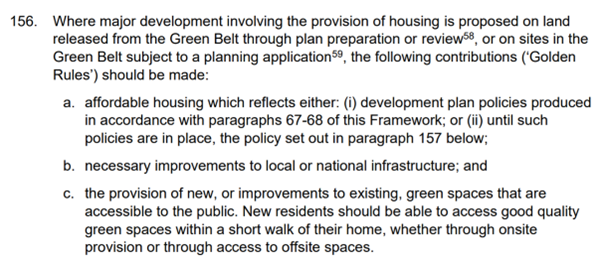
I’m genuinely perplexed by these rules. Part (a) on affordable housing, by referring to paras 67-68, essentially says that development on Green Belt sites should deliver more affordable housing than non-Green Belt sites. That’s a valiant attempt to make Green Belt incursion more impactful on the chronic shortage of affordable homes, although in my view this needs to be considered with the sustainable location question: is it a sustainable location for people who can’t afford to rely on a car or on taxis or on those rather expensive train and bus fares we have these days? I strongly suspect not. But we needn’t worry, because that trusty steed the viability clause comes galloping to the developer’s rescue in para 67, so they can easily talk the affordable housing component back down to something more in line with their usual rates.
166(b) and (c), our second and third Golden Rules, are literally superfluous, because contributing to necessary infrastructure and green space is what’s expected of all development, everywhere. Let’s face it, the Golden Rules are words taking up space on a page, and that’s all.
But back to our students. They fully grasped that our fictional test site probably qualified as grey belt, and also that para 155 builds in so much contingency that when I asked them, ‘will it make it more likely that the site will get planning permission?’ the general feeling in the room was ‘probably not’.
Let’s now rummage through our toolbag and pull out Occam’s razor. What do all these new, convoluted words really say, when you pare it down? Here’s my version:
If there is unmet need at the time of the decision, then encroaching into the countryside to meet that need is acceptable in the Green Belt, unless it fundamentally harms the strategic function of the Green Belt. Weighing unmet development need against the strategic function of the Green Belt therefore now rests with the decision-maker determining each planning application.
If you don’t like Green Belts, you might support that approach. But I don’t think you should, because there are absolutely inevitable consequences of having a wildly over-complicated formulation of policy, that loads big strategic concerns onto development management: inconsistent decisions, appeals, legal cases, costs, delays, and further reviews of the policy. In fact it’s so complicated that, while I was writing this blog, the government published 3,000 words of Planning Practice Guidance to explain it.
The solution is strategic
Since Green Belts came into being, there have been two key changes to the circumstances they operate in, both of which create a case for substantially overhauling them. The first is that they were designed to complement public housing and New Towns programmes which were subsequently emasculated. The original strategic concept was to concentrate new development into distinct areas, with Green Belt delineating them and keeping the countryside close to them. The delineation has largely held, but the highly-focused development has been weakened by loss of land value capture mechanisms and the general abandonment of public housing.
The second change is that the climate and nature crises have emerged since Green Belt, and Green Belt lacks the tools to act on those crises. Green Belt presumes that containing urban areas and preventing their merger produces a default sustainable outcomes, but this has never been properly tested. In some cases, it’s quite possible that combining a cluster of existing settlements into a town, with good greenspace network, that can support a viable railway station, a secondary school and some healthcare facilities would be a far more sustainable outcome than the status quo. Looked looked at this way it seems fairly obvious that strategic scale reviews of Green Belts are needed that start from the premise of creating sustainable settlement patterns and healthy, climate-ready, nature-positive settlements. If you don’t believe me, check out this excellent article in the TCPA Journal. Then the strong protection from development that Green Belt policy affords can be used to reinforce that pattern. The new Spatial Development Strategies are the right scale at which to do those strategic reviews, and rethink what a Green Belt can achieve. Most importantly, this means that some good brain power – of which there is no shortage – needs to be channelled into establishing what a genuinely good strategic Green Belt review should look like, with fair-minded input both from the detractors and the supporters of how existing Green Belts are configured. Different Green Belts work differently, so some place-based adjustments of the Green Belt purposes seem eminently sensible. And we mustn’t forget those areas that don’t have any Green Belt at all, because they also need some strong place-shaping tools that are currently absent.
This process would take a few years to work through into Local Plans, but the anti-strategic nature of grey belt could be very damaging to this, distracting local authorities with a rash of random sites they have to grapple with through development management. Understandably, a government setting itself a short-term target to dramatically increase the pace of housing development is reluctant to wait that few years. But NPPF could have been adapted much more simply to assist this, by being much more specific about what constitutes a sustainable location, and empowering the decision-maker to give greater weight to a sustainable location as a benefit, against the in-principle harm of a Green Belt location. Crucially, this would also shift the focus of a site’s promoter away from demolishing the local authority’s five year land supply evidence, and onto proving how their site is, or can be made, sustainable.
 goodplanconsulting.co.uk
Leave a comment