

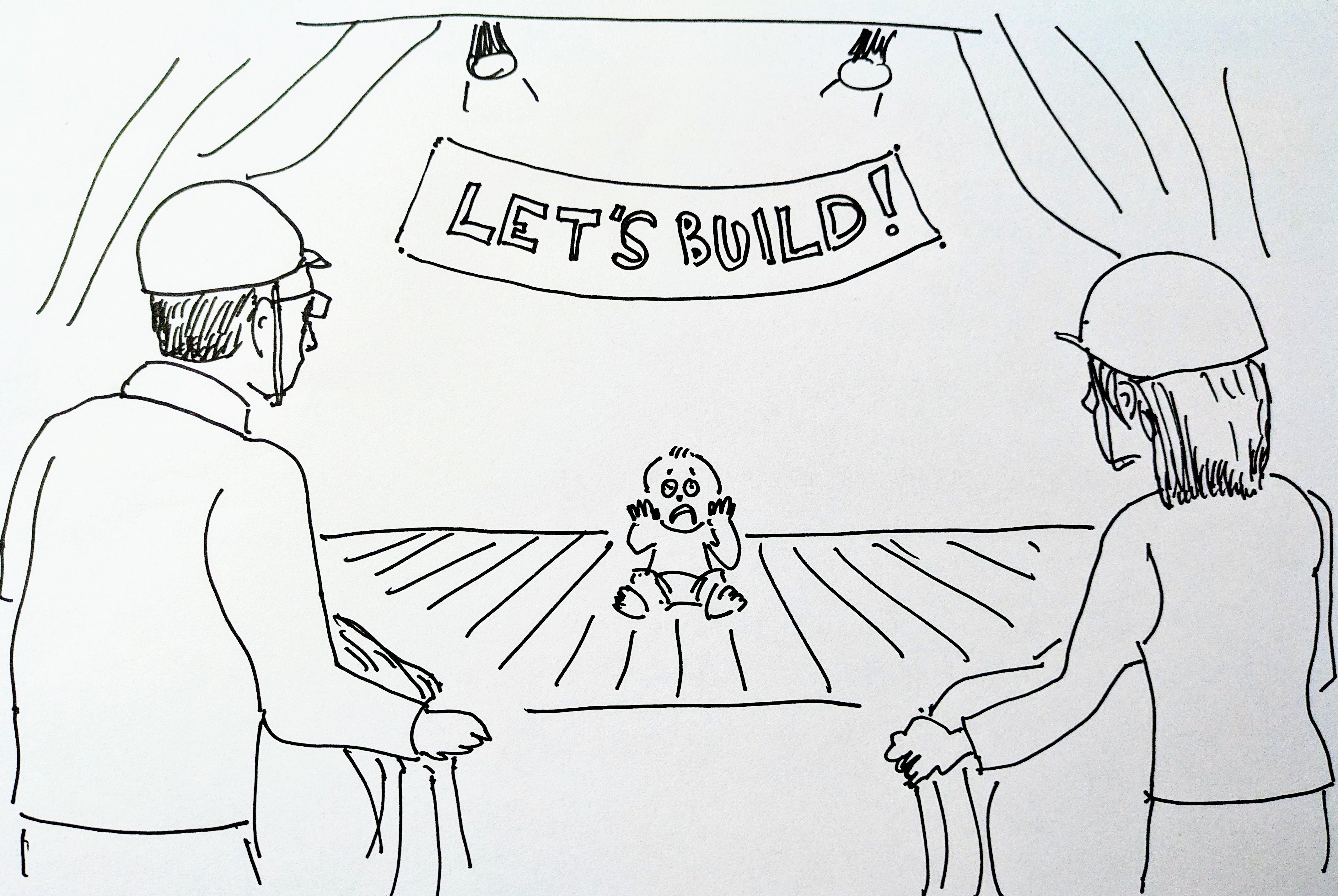
It’s time for government to stop infantilising the task of building homes.
The government’s current raft of planning reforms are mostly well-intentioned, but not all are well-conceived. Like me, you’re probably worried when its cheap jibes – about newts or snails for example – turn into the hasty and damaging legislative proposals we’ve seen in Part 3 of the Planning & Infrastructure Bill. See Sally Hayns’ excellent TCPA blog for more on this. Now the government has gone a step further: quite literally infantilising its mission to build more homes by inserting the word ‘baby’ into its mantra. I can’t bring myself to say it. But taking inspiration from a certain, highly divisive global figure – with a pick-and-choose approach to democratic and legal due process – who coined his version of the slogan to describe doubling down on fossil fuel extraction – is not a good look.
Planning needs reform in all sorts of ways – we can get into those. But we need to start by using actual evidence, not anecdote. The idea that planners and planning are ‘blockers’ to growth just doesn’t stack up. Planners are doing an amazing job and it’s simply wrong to blame professional planners, planning committees, or nature, for sluggish development.
Some months ago, I posted on LinkedIn in response to the publication of the latest planning performance statistics. It came at a time when planning was yet again being blamed for sluggish rates of new development, a criticism that rarely goes away. Recently, I decided to revisit these statistics. Once again, I found that the picture of planning system performance is surprisingly clear, and it contradicts the hype.
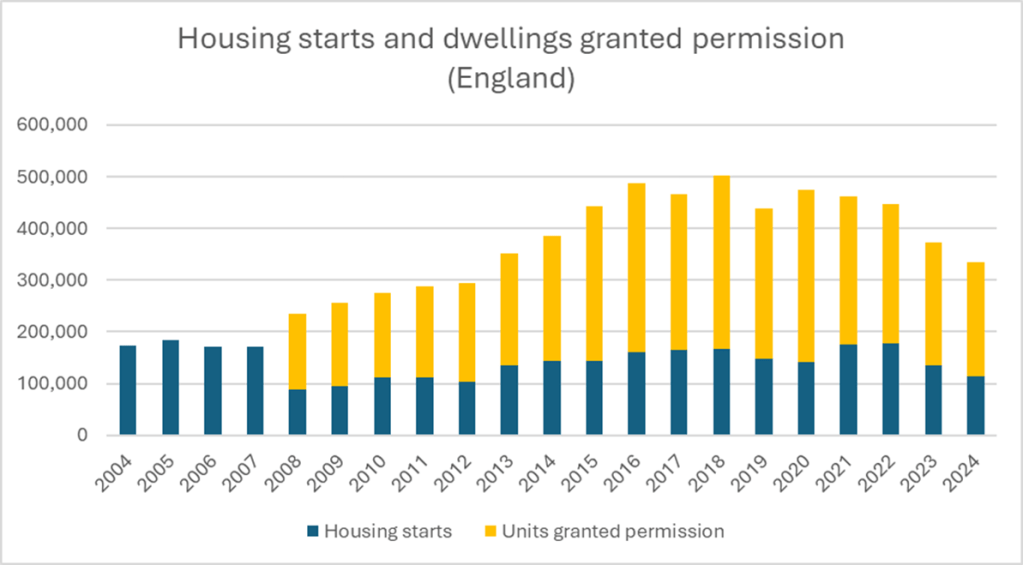
Research by the Local Government Association in 2021 highlighted that permissions were not translating into homes on the ground. They show that residential permissions have been far exceeding the number of completions for several years, creating a mountain of over 1 million unbuilt permissions. Shelter estimated in 2020 that 40% of permissions between 2011 and 2019 remained unbuilt. I wanted to bring this data up to date.
Of course there is the lag time between a planning approval and the building actually happening: on larger sites (which make up the majority of housebuilding) progressing from an outline approval to a completion will inevitably take several years, so policy or market interventions take some time to bear fruit.
We can go some way towards adjusting for this time lag by comparing approvals with housing starts instead of completions. Even then, this starkly shows actual housebuilding hovering stubbornly between about 100,000 and 180,000 over many years, and a backlog of over 1 million unbuilt permissions. It’s hard to understand, then, how further boosting permissions could fix the problem – which begs the question – what’s really going on?
Source: https://www.ons.gov.uk/peoplepopulationandcommunity/housing/articles/ukhousebuildingdata/overview
The ‘units granted permission’ data has only been collected since 2009.
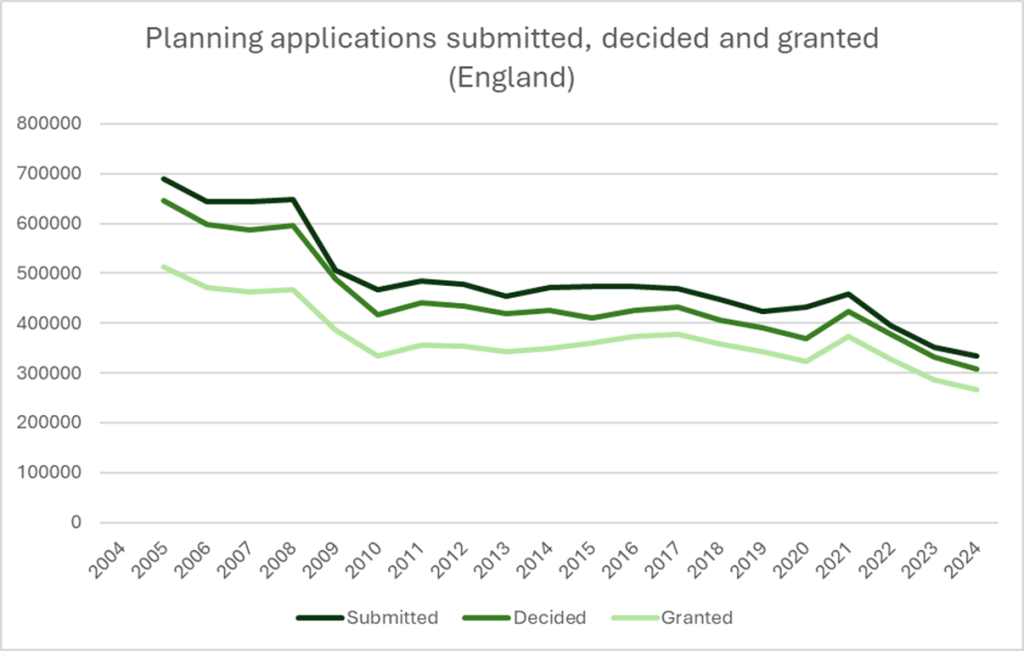
Incoming applications are down
It’s true that the total number of planning applications in the system is well down compared to 20 years ago, stabilising in the years after the 2008 financial crash and then falling steadily since 2021. Whilst I haven’t found data to show a causal link it seems likely that the well-documented increase in build costs and supply chain problems we’ve seen in the construction industry since COVID have also contributed to suppressing the flow of applications for development.
Source: https://www.gov.uk/government/statistical-data-sets/historical-and-discontinued-planning-live-tables
Decision-making is not slow
91% of major applications are approved within their agreed time, rising to 93% for those with a Planning Performance Agreement, Extension of Time agreement and/or Environmental Impact Assessments (EIAs). So there is no problem with the speed of the decision-making itself, and EIAs are not the problem either. Of course this doesn’t mean there aren’t delays, and some of those delayed cases will be high profile and arduous. But at the system level, speed is not the issue.
Planning Committees are not the problem
The proportion of planning decisions delegated to officers has been stable at around 96% since 2014, having previously increased from around 75% in 2000. Therefore, when there was a historically much higher flow of incoming applications there was also a much greater use of Planning Committees. A study by Lichfields took a sample of 309 appeals on major residential applications, and found that where an application was refused by a Planning Committee against an officer recommendation to approve, 65% of such cases were approved on appeal. This is not surprising – in fact I would expect the proportion to be greater – because officers’ reports are the product of extensive professional work and tend to give an appellant a clear insight into why officers had been minded to approve. However, there is no reliable data for the proportion of applications that Committees refuse against their officers’ advice. But with only 4% of applications going to Committee at all, the impact of those refusals must be statistically low. All Planning Authorities and most larger developers will experience the disproportionate resources that fighting those battles consumes; and they are also exhausting for affected communities. But the data shows they cannot be causing a housing supply problem in the overall picture.
It’s important to refuse poor development
Around 75% of residential applications are approved. Given the 96% delegation rate, almost all of those 25% of decisions being refused or withdrawn must be happening either under delegated powers, or by committees following officer recommendation. Which means that, with a few rogue exceptions, those 25% of schemes are refusable against the development plan and NPPF, based on grounds that can’t be adequately resolved by conditions. Or, to be clearer, those that are refused should be refused, and therefore the system is working well.
This is the reality to which the current government appears wilfully blind, regarding refused applications as a rich seam of potential approvals if only the goalposts were moved to reduce their likelihood of refusal. The government has so far tried a number of measures to shift those goalposts:
- reducing the impact of planning committees and their irritating habit of providing local democratic accountability – we’ve already dealt with why that won’t help;
- the desperately ill-conceived Part 3 of the Planning & Infrastructure Bill, to remove ‘blockages’ resulting from that pesky need to protect nature and mitigate impacts – despite the government having no evidence to support its rhetoric;
- introducing ‘grey belt’, to prevent applications in Green Belt from being refused on Green Belt grounds.
On this third measure, there is certainly evidence that grey belt policies are leading to more approvals in the Green Belt. A study by planning consultancy Marrons found that 49% of Green Belt appeals were successful during December 2024 to March 2025, since the policies were introduced, compared to 31% in a similar period the previous year. It may be too soon to tell how much effect this will have on overall housing delivery, but without knowing what share of total refusals are on Green Belt grounds, we can’t tell whether grey belt policy will make a dent in the overall refusal rate. And bear in mind, Green Belt is specifically designed to provide reasons for refusing planning permission. See my previous post [here] for more on that.
Alongside this, the policy bar for refusal is already too low, as the country’s continued pattern of poor quality development attests. I’ll go into that fully in another blog article, coming soon. But, as I suggested in my original LinkedIn post, reducing refusals could be partly helped not by weakening the grounds for refusal, but by making schemes better:
- improving the quality of pre-application processes – to filter out unacceptable applications and reduce the problem of applications being refused on grounds of insufficient evidence;
- and improving the quality of the proposed developments.
The government’s comprehensive skills survey of planning departments shows that the biggest skills gaps are in ecology, design codes and masterplanning – precisely the skills that could improve the quality of development. And we must ask ourselves, what proportion of officer time is occupied with rebutting applications that deserve to be refused and fighting appeals that deserve to be dismissed?
Planners are doing an amazing job
There have been severe, ongoing cuts to planning departments since 2010, and we can clearly see that over that time they have continued to process applications efficiently and make good decisions. This shows just what an amazing job planners have achieved, in brutal circumstances.
The planning statistics don’t seem to tally with the government’s proposition that boosting housebuilding relies on generating more planning applications. Crucially, while the number of applications was fairly steady from 2011 to 2020, the number of dwellings permitted more than doubled, which can only be explained by a tendency towards larger developments. And whilst there’s nothing inherently wrong with larger schemes, they will tend to deliver housing starts more slowly. Savills’ study in 2024 also notes the effect of the ongoing consolidation of the housebuilding industry. Throughout the 2000s, the average number of homes built per housebuilder was around 35 to 40 per year; now it’s over 80 per year.
More, Smaller, More Productive
The inevitable conclusion is that to get both an increase in planning permissions and in homes built, we need many more smaller developments built by smaller builders, building more diverse products. Planning could help with that, though it certainly can’t do it alone. In my view, the closest thing to a silver bullet would be to segment land supply so that smaller sites can make up a bigger part of the total housing supply, and to provide a regulatory and financing framework that specifically de-risks those sites for small building firms. And crucially for planning, the needs of those small builders needs to come through loud and clear during Local Plan-making, so that Plans allocate the right sites in the right places. In my experience Local Plan processes are dominated by the big guns. But at the end of the day, the small builders don’t need slogans – they need sites, workers and bank loans.
 goodplanconsulting.co.uk
Leave a comment