

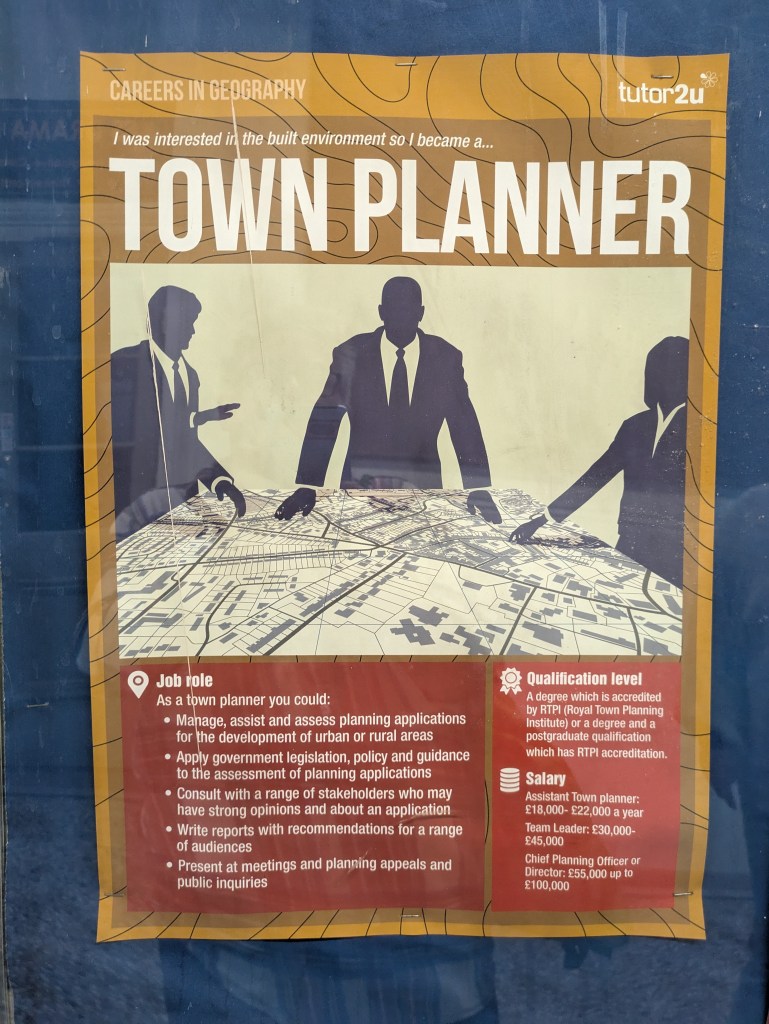
This year is the 30th since I embarked on my career as a planner, starting my Masters course at Newcastle University in 1996. It’s safe to say at that time I had no plan for my career, but it’s worth reflecting on a few of the emerging issues that I remember from the world of planning back then.
There was a pressing need for urban regeneration in most cities, with post-industrial decay still an issue, and town centres further blighted by the hollowing-out caused by out-of-town shopping. Comparison with European cities showed us that low-to-medium-rise densification paired with good urban design could raise inner urban populations, support more amenities and make places more sustainable. This gave rise to the Urban Taskforce Report in 1999.
In the wake of the privatisation of utilities and public transport, there was evidence of a two-tier system emerging where more affluent consumers enjoyed better, more affordable public services than their less well-off neighbours, and the risk that this would deepen spatial inequalities, including fuel poverty. Around 30% of the working age population were not economically active.
Housing standards, especially in the private rented sector, were poor.
There was very uneven access to public space and green space from one neighbourhood to the next – this sparked my interest for my dissertation which looked at how planning for networks of accessible, multi-functional green spaces could help places to become incrementally more sustainable and attractive. This pre-dated, by a few years, the emergence of green and blue infrastructure as concepts in planning.
It was the time of the Kyoto Summit (1997) and the growing sense that the time for meaningful climate action by governments had come.
How much progress have we made over those 30 years?
Interestingly and perplexingly, progress has not been linear but has fluctuated. Planning policies to protect town centres and prioritise brownfield land have ebbed and flowed. The train I’m on while writing this has passed at least half a dozen large new-build housing schemes where hundreds of homes are being built with no evidence of a shop or other amenity in sight, locking in car dependence for decades to come – one of the most shameful failures of our current system. There have been many initiatives to boost housing standards but very few have lasted more than a few years before being scrapped and replaced. On climate, we nearly got a zero-carbon homes standard in 2016, and then we didn’t. Fracking was in, then out, then nearly came back, then went away again. Wind energy was in, then out, then back in again. HS2 dangled the potential to revolutionise rail capacity in the country’s industrial heartland, and then snatched it away again.
The lesson I take from this is not to expect any policy to last. Look at Biodiversity Net Gain: just when we thought we’d scored a real win for nature in development, the goalposts were moved even before the leftovers from the celebratory dinner had gone cold, never mind waiting long enough to see what the actual outcomes for places and nature might be.
Imagine if we’d had a 30-year plan to tackle some of these issues, instead of this constant flux!
The purpose of planning
There’s been quite a bit of discussion lately about the purpose of planning.
The draft new NPPF (para 14) states that “The purpose of the planning system is to contribute to the achievement of sustainable development, by managing the use and development of land in the long-term public interest”. But what does that mean? What is the public interest, and how long is long-term? This statement of purpose is drawn from an RTPI briefing, which expands as follows:
“The purpose should recognise that planning has a role in:
a)addressing the long-term common good and wellbeing of current and future generations,
b)having full regard to the achievement of the commitments under the under the Climate Change Act 2008 or the Environment Act 2021
c)according with the United Nations Sustainable Development Goals, and
d) delivering fair planning processes that are open, accessible and efficient.”
Should we be worried that the two key pieces of UK legislation referenced in the RTPI briefing are not referenced in the NPPF draft? I’m inclined to think we should, because the government resisted a sustained campaign from across the profession to get a statutory climate duty enshrined in the new Planning & Infrastructure Act, despite equivalent duties already existing in the devolved nations.
I sense that a missing ingredient in this discourse is a grasp of the time dimension. Over what time period are we aiming for results? The word ‘planning’ implies preparing for things we expect to happen in the future, in order to try and shape the outcome. Of course, things will never turn out exactly as you envisage, and some events along the way will require changes of emphasis, but if you have identified a problem and mapped out a timeframe over which you think it can be addressed, you can monitor what effect your policies are having, and adjust accordingly. This chimes with the quote usually attributed to General Eisenhower: “plans are useless, but planning is indispensable”; in other words, don’t expect things to turn out as you planned, but the thinking you’ve done to create the plan will equip you to understand and respond to shifting circumstances.
My former employer, Yorkshire & Humber Climate Commission, developed a suite of regional policy principles including a statement that “the overarching purpose of planning should be to create healthy, just and sustainable places in the changing climate”. Whilst NPPF’s language is somewhat more technocratic, if we were to define “healthy, just and sustainable places in a changing climate” as being the key tenets of “the long-term public interest” then perhaps the planning system might be heading in the right direction. But we still haven’t talked about the time dimension.
It’s the jobs, stupid
I suspect that if you asked ministers in the current government what the purpose of planning was, they would give the reductive answer “to deliver housing and economic growth” (which, you’ll notice, has no temporal or spatial dimensions, it’s just a pipeline). I don’t want to get bogged down here in the pros and cons of economic growth at the philosophical level but, it is clear to me that growth needs to be seen as a means, not an end. The end goal is a prosperous, thriving society, in which the social contract between government and citizen is sustainable in all senses of the word. Economic growth is one of the mechanisms to deliver that, but it can’t be the only one – if we put all our eggs in that basket then the long-term public interest won’t be served. This is because, in the places that most need their local economies to grow, the key drivers of local growth – increasing sources of employment and a growing, economically active population – are not in evidence. Despite various initiatives and public investment in services, benefits have been concentrated where the greatest numbers of economically active citizens can take advantage of them: principally in the overheated South-East and a few other major cities.
We know that trickle-down economics don’t work at the national scale, because places like Hartlepool are not benefiting from London-centric growth. Nor does trickle-down work sub-nationally; if it did, places like Blackpool would be in much better shape. Jobs need to be available within the immediate reach of the communities that need to benefit from them. There also needs to be a good mix: private and public, investment, the foundational economy, local services, and key workers.
There is a symbiotic relationship between the availability of a wide range of jobs and the availability of a workforce ready and able to do them. Providing that workforce means, firstly, reducing worklessness: helping people within those places by matching them to jobs through training and transitional support, such as flexible work patterns to accommodate caring responsibilities. Secondly, it means increasing the local working-age population, which by simple maths must come from internal migration from other parts of the UK and/or international immigration. And that requires a national spatial economic plan which remains conspicuously absent in England.
What happens if growth proves elusive?
The risks of economic growth not materialising are very high. A lack of a national financial and spatial strategy, combined with hostility towards immigration, means that reversing the trends of declining and ageing populations will be extremely difficult to achieve.
The uncertainties and disruptions being brought by AI seem likely to further destabilise the job market and the roles of anchor institutions. Climate change is also beginning to generate a range of costs and shocks that will put increasing pressure on public services and make investment decisions for businesses riskier.
The purpose of planning then, surely, is to recognise the complexity of the risks coming down the line, and to turn those risks into scenarios that are understandable and manageable. To me, 30 years seems like the right timeframe: long enough for real change to emerge, for institutional investors to expect a return, and for politicians to set goals that other politicians will be charged with fulfilling.
For example, we know that most town centres are in poor shape and that mainstream retail can no longer provide the answers. We know it can take 30 years to turn a place around: an initial phase of land assembly, masterplanning, financing and public sector-led catalyst development needs to be followed patiently by private investment as markets pick up and people find they like being in that place. The reinvention of the Kelham Island and Neepsend area of Sheffield began as a distant vision in the 1980s, and became a successful reality in the 2010s.
Whither the climate?
In 30 years’ time, global temperature will probably be somewhere between 1.5 and 3 degrees C above pre-industrial levels. Where we are in that range will depend largely on the success of global agreements that are not currently going too well, and that forces us to lean further towards worst-case scenarios for what we’ll need to adapt to. In the case of buildings with a 50-year design life and infrastructure with a 100-year design life, 30 years is positively short-term. A trajectory towards 3 degrees of warming would probably mean that fewer and fewer of the buildings or spaces currently in use will be fit for purpose in a few decades time, so the places we’re making now must be future-proofed for frequent heatwaves, cold snaps, storms, floods and droughts. We know that preventative healthcare must logically overtake reactive treatment as the core of our health system, so we need to build preventative healthcare into placemaking.
I was recently talking with some students about climate adaptation, and two worrying points jumped out at me.
Firstly, the temperature increase range of 1.5 to 2 degrees that aligns with the Paris Agreement includes impacts to plants, insects, marine life and exposure to heatwaves that feel, intuitively, unpalatable and hard to adapt to. So the international agreement that we have in place (whether or not the world’s biggest-emitting nation is on board) is actually aiming to limit impacts to ‘quite bad’. And for the UK, a global ‘quite bad’ most likely means significantly higher food prices, significantly more international immigration, and significantly more storms, floods and droughts at home. Does that amount to a reasonable worst case scenario at the place level?
Well, almost. It certainly means that our cities and our countryside will need to be configured around higher costs of living, issues of water and food security, and making infrastructure resilient to compound weather events of a scale and frequency we’re only just beginning to grasp. But there is another problem, which is the other worry that struck me: nationally we are doing not nearly enough to adapt. The Climate Change Committee’s report in 2016 criticised inadequate preparations for future scenarios, and 9 precious years later, in 2025, the CCC found that “adaptation is either too slow, has stalled, or is heading in the wrong direction”.
In fact then, a very reasonable worst-case scenario is not only that climate change impacts have really started to bite in the next 20 to 30 years, but also that central government has spent at least another 10 years procrastinating, and the lead time for on-the-ground adaptations has been used up. The crucial question in that case is, to what extent can places – local and strategic authorities – take the initiative to be ready for this deeply uncertain future, if central government isn’t facing the facts?
Career-scale planning?
Reflecting on my 30 years in planning so far, and reflecting on the fluctuations in the policy context over that time, leads me to wonder about reframing the planning challenge as a professional one, rather than a government one. What if “being a planner” meant signing up to a career-spanning, generational scale mission “to make places healthier, safer and more just in 30 years’ time than they are now”? A sort of time-based Hippocratic oath to placemaking, if you will?
I know I, for one, would rather live in a place that had cracked on with envisioning the future than one that hadn’t – for the sake of our children and grandchildren. Speaking to those 19-year old students recently, I had to be frank with them: “My generation has worried about the climate, but we haven’t meaningfully acted. So I’m sorry to say this is going to be your problem.”
We can be pretty sure that without planning, without policy interventions, things look pretty bleak in 30 years’ time. That means giving up is not an option, because intervene we must. But it also means that having some clear-eyed scenarios for 30 years hence – and plan to achieve the better ones.
 goodplanconsulting.co.uk
Leave a comment