

‘
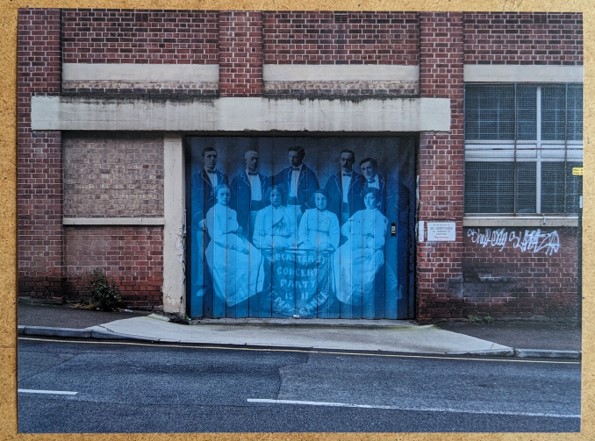
‘The Wind Engine’ is the sixth story in the ‘Orchard to Orchard’ series I created in collaboration in 2024, with photographer James Sebright. The series imagines lives interacting with one site in urban Sheffield over a 300-year period, combining creative writing, photography, photomontage and archival research.
Extract from the memoirs of Henry Bragg
People had been recommending therapy to me for some time, but it took a while to find the right therapist. In March 2047 I found Matthew Hunter, and he told me flatly that I was a racist and a sexist. I asked him, “If a racist doesn’t respect other races and a sexist doesn’t respect the opposite sex, does that mean a therapist doesn’t respect therapy?” He said it was me who needed to respect therapy, and it didn’t matter what he thought.
I didn’t like being criticised like that, but I realised he had a point. Of course he traced it back to my childhood. At school in the 2010s, I had to go along with the idea that it wasn’t cool to be too smart, especially as a boy. But there was a girl called Efia, her parents moved from Ghana and she was good at absolutely everything from science to art to sport, and she was cool with it. There was a Latvian guy too, I forget his name, but he was an overachiever as well. And I remember thinking that maybe foreigners and girls were just more powerful humans than me. It made me afraid of them, I think.
Then at University I met Maita. There were loads of students from China and Malaysia, but Maita was from Zimbabwe and the most beautiful woman I’ve ever met before or since. I was infatuated, and eventually she agreed to go out with me. We married in 2035, but soon after I think we both realised it was a mistake. Women were jealous of her and men gazed at her. Cameras automatically photographed her. After a while I couldn’t stand it, so yes, I became jealous and bitter and I was mean to her. But how does a man with a reputation for being opinionated and visionary admit to being wrong about himself? I don’t think he does.
When I took up therapy I was busy with my big idea – the urban wind engine. Since Maita had finally packed her bags I could work on it in peace. The problem of getting wind energy to work in the city preoccupied me for years. The tall buildings that had gone up in the last 30 or 40 years – you walked past them, and it was always windy, but they created turbulence which made the wind useless for driving generators.
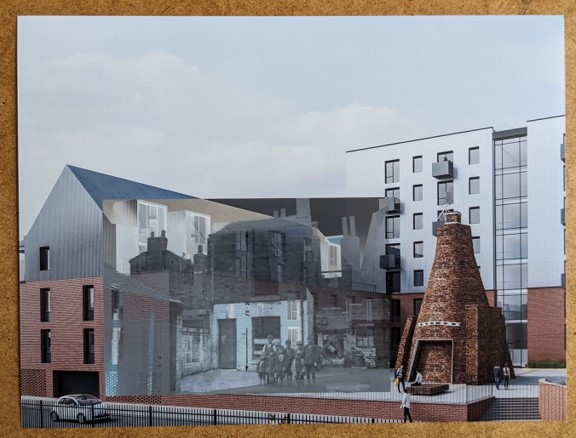
One morning I was walking the dog around Shalesmoor and was constantly being buffetted by these winds, when I noticed the old furnace on Hoyle Street, the one that had been there since time began. And I remembered my Uncle Desmond telling me how he used to think it was an old windmill, one of those pre-industrial ones for milling corn or something, that had lost its blades. I started thinking, what if it really had been a windmill, would it still work surrounded by all these buildings? And I had this idea of controlling the shape of tall buildings control to control and focus the wind so that it would drive a radial turbine.
I wrote a generative 4D augmentor program in which I could test different shapes and arrangements of buildings in a constantly changing wind environment. It gradually began to reveal that I could produce a strong, steady air flow on the outside of a cluster of towers, and a happy by-product was a very calm, sheltered zone inside the cluster, similar to a harbour. I knew I could make these towers into decent neighbourhoods by making the sheltered zones into gardens. Modern homes with plentiful energy and gardens – this could make my name, I thought.
By the time Maita left, the wind engine was working well in the simulator, but I needed a full scale project to test it on. There was a derelict site on Edward Street where some run-down student blocks had been demolished, and I needed to persuade the council to let me build some test buildings on it. With all these climate refugees moving into Sheffield from Somalia and Yemen, there’d be no problem getting occupants for the flats.
My big break came when I met a really good architect to bring on board. Her name was Xiang, she was Chinese, a couple of years older than me, and very clever and good at persuading people. And because she was older, I hoped people wouldn’t say I was just working with her to patch up my reputation.
Thought if I’m honest with myself, I soon realised that I did quite fancy her.


Leave a Reply