

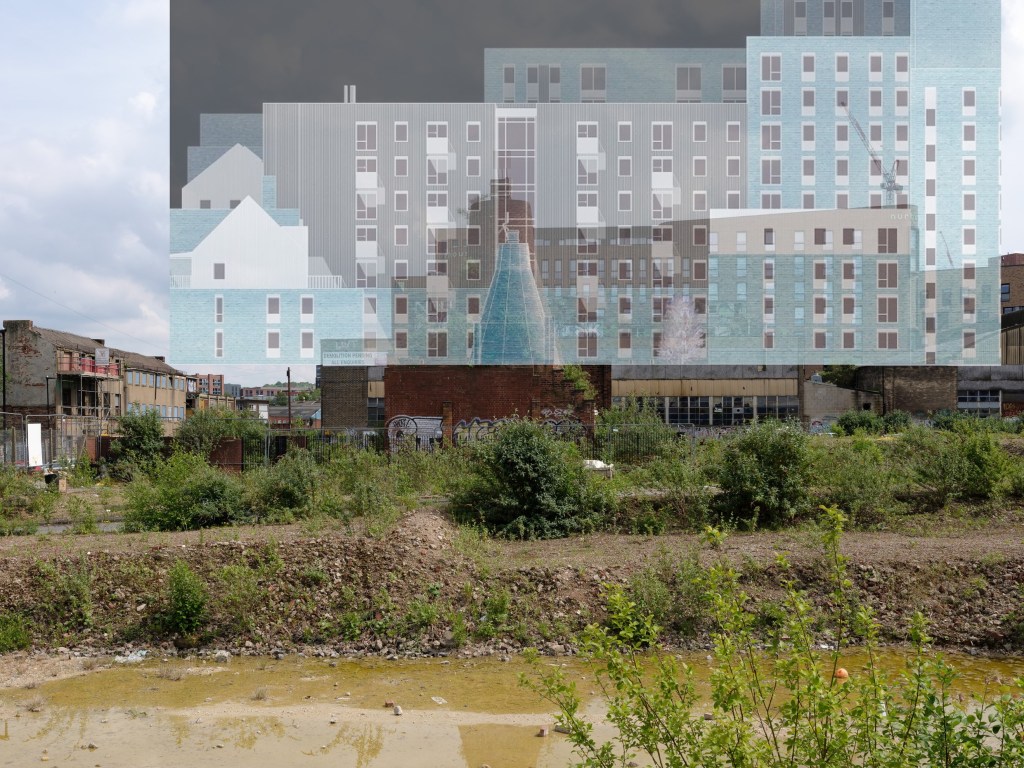
In Spring 2024, I collaborated with photographer James Sebright to tell the history – and imagine the future – of an industrial site in the centre of Sheffield, through the eyes of a series of fictional characters living over a 300 year period, from the 1820s to the 2120s. The work comprises seven stories with accompanying images.
On a quiet side street, not far from Sheffield City Centre, stands the last remaining cementation furnace in the world. Like a beacon, a time-traveller from the past, it presides over the empty land on which it now finds itself, which is set to become a development of student apartments – with the furnace, as a cultural relic, at its heart.
On the verge of extinction, the furnace is emblematic of the industrial story of Sheffield, whilst the site itself embodies how land use rapidly changes over time – more rapidly than we tend to appreciate. The whole reason why Sheffield is what it is – and will still be here in the future – is because of sites like this, and is expressed by the furnace, which gives the site its cultural significance. Yet of course this piece of land has a history before steel came to Sheffield and will continue to do so when the student flats have long since been knocked down to make way for something else.
Based on extensive archival research and drawing upon professional expertise, through seven stories we take the reader on a journey spanning almost 300 years, from when the site was an apple orchard on the outskirts of the city, to an imagined future where the site is once more an orchard within a post-industrial version of the city. On our journey we meet numerous characters who may well have populated this landscape, causing us to contemplate the fact that history is filled with people who have more in common with our modern-day selves than we perhaps realise.
Stepping back and looking through the lens of this extended timeframe, we are able to see how ephemeral even the most seemingly substantial uses of the land are – even the heyday of the industrial revolution when Britain was the wealthiest nation on the planet.
These stories are accompanied by a series of images created by the blending of archive imagery with present day photographs of the site. These juxtapositions are an attempt to stretch the possibilities of what is a time-bound medium and take on new meanings when juxtaposed with written evidence of pasts and futures that are not currently visible.


Leave a Reply