

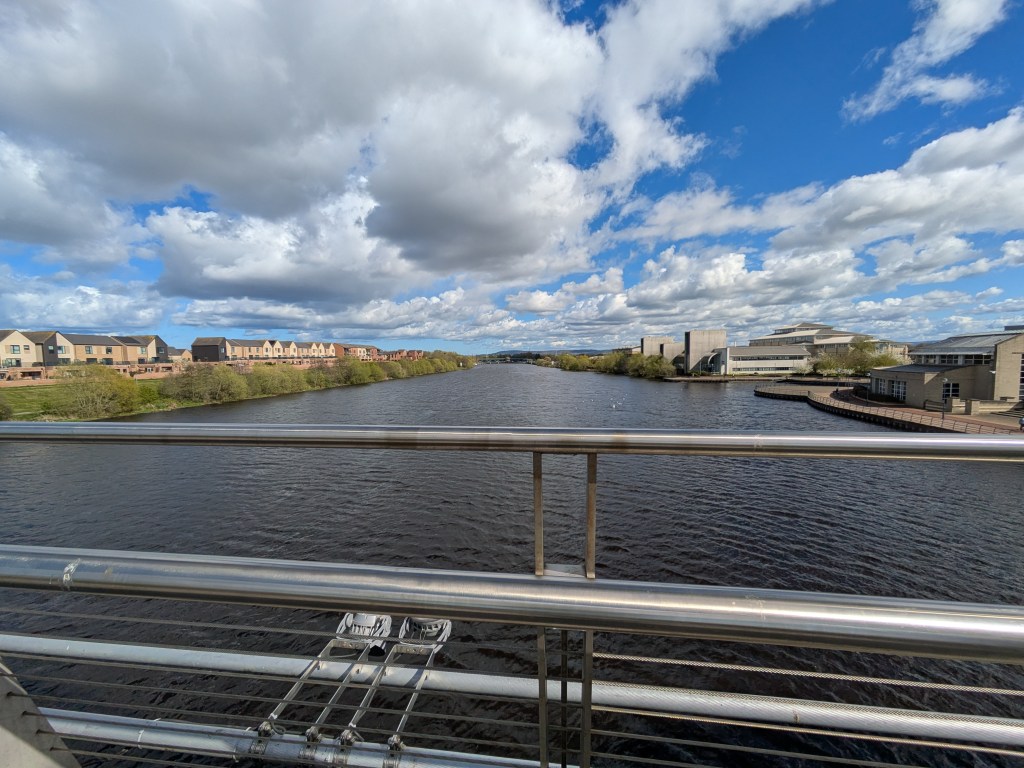
Although I describe myself as a Planner who first trained in Architecture, I’ve eventually come to realise that, more than anything, I’m a settlement geographer. Why settlements are where they are and how they are, and how to make them work better in a changing world, is what really interests me professionally, above anything else. And water is totally inseparable from that.
I remember about twenty years ago, sitting outside in my small urban garden one evening, gazing meditatively at the rooflines of the terraced houses surrounding me, and the cloud patterns in the sunset. I heard a toilet flush somewhere, and it hit me that the single most important thing keeping the city around me functioning was its ability to carry away and treat our waste water. Without that, we’d be up to our knees in our own excretions like we were forever stuck on the third day of a music festival. And of course there are people in the world who do have to live like that – just without some best-forgotten old band turning up.
Yesterday, I attended a fascinating seminar by Dr Sagnik Das, Junior Research Fellow at the Indian Institute of Technology, Guwahati. He is currently researching relationships between nature and culture in the Deepor Beel, a freshwater lake that is an internationally significant nature reserve and has supported generations of families through fishing. Sagnik posed the question: in the Anthropocene, can a multi-species culture truly co-exist? I took this to mean, can we allow elephants to be elephants, and the many species of wetland birds to be themselves, or do we inevitably force them to conform to the version of the place that humans have made?
Then, with this morning’s first coffee, I began reading Robert MacFarlane’s “Is a River Alive?” This looks at the various schools of thought that attribute personhood, legal rights, and spiritual autonomy to rivers. Let’s call it an animate approach. MacFarlane is a poetic writer of prose, always able to make heavy philosophical ideas unputdownable. I don’t yet know whether he’ll mention the River Dôn Project that is exploring this very notion within my own home catchment in South Yorkshire, aiming to weave new connections – synapses, perhaps – between humans and the many organisms we share our landscape with.
Granted, this may all seem a little too left-field for some. After all, don’t humans have enough trouble providing justice and accountability for other humans, without taking responsibility for everything else in some sort of Gaia Theory-inspired saviour complex? Surely we should just figure out how to stop fouling our own nests, and then nature will happily look after itself?
Well, I’m leaning towards the animate approach, for a few reasons. Firstly, if society is already taking seriously the idea of treating machines as conscious beings, then it seems we’re quite ready to ditch the principle that something has to be made of organic cells that are in the process of growing and reproducing for it be ‘alive’. Secondly, if it provides a useful proxy by which we can work out how to do that co-existence that Sagnik Das is asking about, then maybe that will prove very useful down the line, so it’s worth a try.
My third reason is the main one, and it’s much more practical. Our current, inanimate approach to our relationship with water isn’t working. Despite the great skill and dedication of people working in the relevant institutions – the Environment Agency, Natural England and yes, the water companies – we’re in a heck of a mess in terms of water supply, river pollution, flood risk and depleted ecosystems. Whilst I would defend those institutions myself, it’s not too surprising that they’re facing existential risk themselves. And the first of the new Environmental Delivery Plans, which aims to take a more strategic approach to addressing water and nutrification pressures in the Norfolk Broads, has all the signs of being deeply flawed and should almost certainly be sent back to the drawing board.
But how do we give these non-human players agency without asking them to play the humans’ game (which is a version of Sagnik’s question)? We’re familiar with how a colony of beavers can fix up an ecosystem with the same apparent ease that a five-year old human can play Mario Kart. Neither the beaver nor the child would have the slightest interest in joining a committee. I don’t know. Answers on a postcard, please.
What I do know, as a settlement geographer, is that our planning and our architecture need to get to grips with these water issues very urgently. Recently I’ve spent time in several places whose relationship with water is being increasingly tested by climate change, in Hull, Skegness and Lowestoft. They’re very different from each other, but they’re all products of the simple fact that humans will always settle as close to water as they can, even if this means the water sometimes gets in. And what we’ve done, in the industrial age, is we’ve built right up to and on top of rivers, drained wet soils, put rivers into pipes, and so on, and then wondered why we’ve annoyed the water into acting up. It’s like putting your cat in a box and then wondering why it yowls angrily at you.
There are some great projects now opening up and transforming urban rivers, not least in my own city of Sheffield, un-hiding and welcoming the water. It’s the only way forward, really. But it concerns me that the planning system’s core approach to flood risk – don’t build where it floods – is doomed to failure for the very reason that we are riverbank and shoreline animals. The new National Planning Policy Framework (NPPF) embeds a presumption that building on land within an existing settlement is acceptable in principle. But maybe if we’re going to successful at Living with Water, as Hull aims to, then we need to consider giving water first refusal on urban land that becomes available, before we confirm the principle of building on it? In any case, the new building won’t be able to function without water flowing through it in a designed way. Perhaps instead of ‘brownfield first’ we should be talking about ‘water first’. If the water doesn’t want it, then it can be ours.


Leave a Reply